This lecture is co-sponsored by the Mosse/Weinstein Center for Jewish Studies.
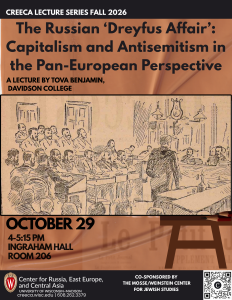
About the Lecture: The year 1894 saw two highly publicized and controversial trials in Europe, both involving Jewish men by the name of Dreyfus. The first of these scandals was a canonical moment in French and Jewish history: the arrest, and sensationalized trial, of Captain Alfred Dreyfus, falsely accused of espionage. The second, lesser-known Dreyfus scandal involved the arrest and trial of Jewish agents connected to the Louis Dreyfus & co., an international French-Jewish export firm, and one of the most prominent firms in the Russian Empire’s Black Sea region. Also called the “Dreyfus affair” by the Russian press, the case concerned the alleged sale of corrupted grain to starving regions of the Russian interior during the 1891 famine. While the French Dreyfus affair revealed the limits of Jewish assimilation into the French Republic, the Russian affair seemed to reveal the significant role of an otherwise marginal group in the empire’s all-important and globalizing grain trade. This talk will discuss the changing grain economy at the fin-de-siècle and the making of the Russian “Dreyfus affair” in this context. Considering the Russian affair alongside events in France, it asks how this history can contribute to our understanding of a pan-European moment of capitalism, antisemitism, and nationalism in the late nineteenth century.
About the Speaker:Tova Benjamin an Assistant Professor in the Departments of History & Russian Studies at Davidson College. Her current book project documents the social upheaval and ethnic conflicts in fast commercializing regions of the Russian empire’s agrarian south during the booms and busts of the Black Sea grain trade and export. Her research has been supported by the Social Science and Humanities Research Council of Canada, the Memorial Foundation for Jewish Culture and the Frankel Institute for Advanced Judaic Studies at the University of Michigan, where she is currently a 2026-2027 Frankel Fellow.